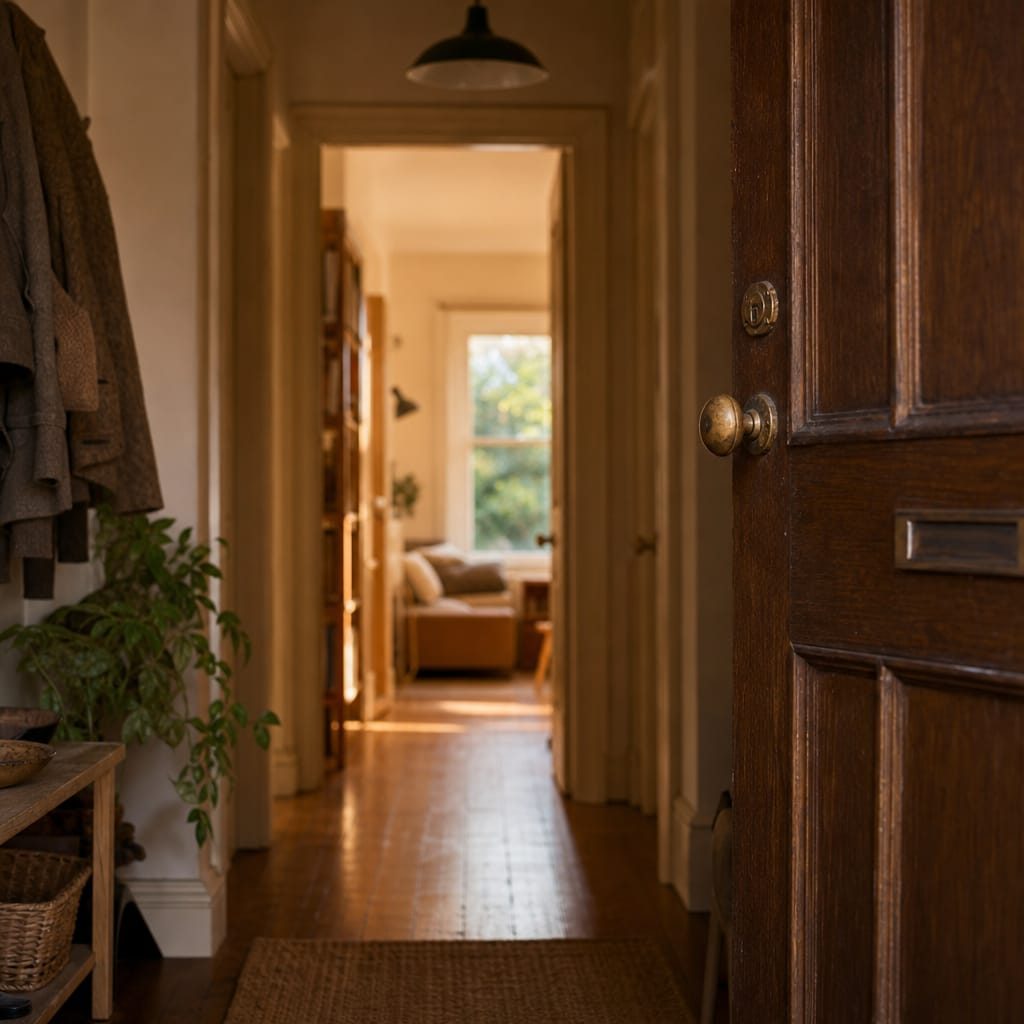
There's a specific moment that most people have felt but never quite named. You've been away – a week in Lanzarote, a long weekend at your sister's, even just a late night out – and you step back into your own hall. The particular smell of the place hits you. The specific quality of the silence. And for about thirty seconds, you feel home more intensely than you ever do while you're actually living there.
That's not sentiment. That's neuroscience being slightly strange.

Why does the feeling of home fade after thirty seconds?
What's happening in those thirty seconds is that your brain is doing something it does brilliantly: comparing what it expected against what it's receiving. Your whole life, without you asking it to, your brain has been building a detailed internal model of your home – the exact angle of light in the kitchen at six in the evening, the sound the boiler makes before it clunks into life, the give in the second stair. It updates this model constantly, the way a map gets redrawn. When you're away, the model ticks on but the updates stop. You return and suddenly the real thing and the model are being run against each other at high speed, and that match is almost perfect. The matching process produces a rush of something recognisable as belonging. Psychologists call the broader phenomenon place attachment. Your brain has, quite literally, constructed a feeling and called it home.
What makes this genuinely odd is that the same machinery is running when you anticipate a holiday rather than take one. The brain's reward system fires harder during the wanting phase than during the having phase – which is why the two weeks before you go are often more exciting than the two weeks you're there. Anticipation is the brain projecting a perfect version of the experience without the sunburnt shoulders or delayed flight. Home works the same way in reverse. Absence does the job that anticipation does, briefly, and arrival is the payoff.
Why a Nicer House Can Feel Wrong
This also explains why people are often unsettled when they move somewhere objectively nicer. Bigger garden, better light, no dodgy neighbours – and yet it feels wrong for months. The new place hasn't been absorbed into the model yet, so your brain keeps running the old map and finding mismatches everywhere: the light switch is on the wrong side, the pipes sound different, the silence has a different texture. Home isn't where you live. It's where your brain has finished doing the cartography.
Why Small Changes Land Badly
It also explains why small changes to a home can land badly even when they're improvements. You repaint the hallway a colour you love and spend a fortnight feeling faintly uncomfortable without knowing why. It's not the colour – it's the gap between the room you're seeing and the room your brain was expecting. Given time, the model updates, the discomfort goes, and the new version becomes the one you'll miss when you're away. Your home, in other words, is always slightly behind you.
Questions this raises
- How long away do you need for it to happen?
- Does the same effect explain homesickness?
- Can you feel it in a house you dislike?