An ex midfielder, sitting on a studio sofa, offering wisdom to a player, saying things like ‘he just needs to back himself more’ – that man is a pundit. And ‘pundit’ is a word that has plummeted from a great height.
Where It Started (Somewhere Considerably More Demanding)
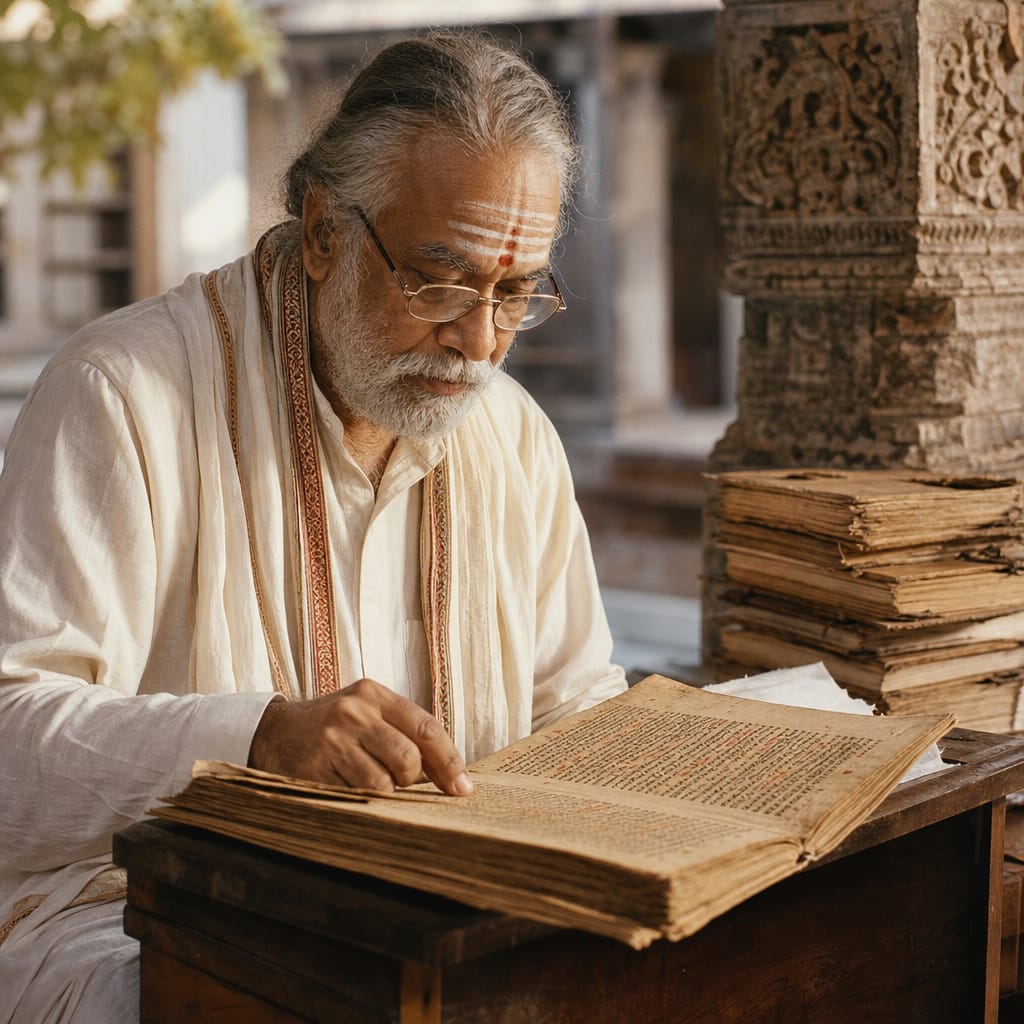
"Pandita" is a Sanskrit term used to refer to a learned scholar. In terms of the Vedic stream of knowledge a pandita is someone who has mastered the Vedas to the point where he can verbally recite the text from memory. The Vedas are some of the oldest surviving bodies of human knowledge. This knowledge was orally transmitted through generations of teachers and students with 100% accuracy down to the last letter or syllable. Therefore any error with the Vedas is not a trivial mistake that may cause temporary embarrassment to someone. It is a serious error of cosmological proportions. Such a person would have studied long and hard for many years, and sometimes decades, in order to attain such a high level of expertise in the subject.
The Colonial Detour Through English
These scholars were encountered by the British colonial administration in India, the word borrowed and slightly anglicised to describe learned Indians generally. By the 19th century the word ‘pundit’ had appeared in English written texts and, still meaning something close to ‘deeply learned expert’, was used by governments and newspapers of the day and travelled well because it sounded authoritative without being too specific. English has always been a language happy to import words of authority.
In Britain, once settled, this word began to drift, and it started to mean ‘anyone who purports to be an expert and speaks with conviction’. They’re a very familiar category on TV these days, and I’m sure you can think of many who fit the bill without needing to go into too much detail.
Pundit is hardly the only word that's done this quietly. This piece on newsbug.co.uk does something similar for a far more domestic word: Damp Has Three Dialects, and They Are Not Saying the Same Thing
The Studio Sofa as Sacred Space
Television sport found a gap in the time between the end of a match and the end of the programme, and a word, the term “pundit” (learned person in a field), to describe a retired player who has watched a lot of football and thus has formed many strong opinions about the pressing triggers of the game. The word fit only loosely.
There is something slightly comic about this when you consider that the NHS recommends:
"do at least 150 minutes of moderate intensity activity a week or 75 minutes of vigorous intensity activity a week"
NHS, Physical activity guidelines for adults aged 19 to 64
Most people who follow a sport spend a lot of that time watching someone who used to meet that requirement explain why his former team went 2-0 down. A lot more people are observers of sport than participants. The pundit is, in a way, their official representative.
This is what a ‘Pandita’ once was: someone who held knowledge so the rest of us did not have to carry it around. Sports coverage works on the same logic: commentators are ‘Panditas’ of sporting knowledge. We just borrowed the title and changed the content considerably.
—
Does "pandita" still exist as an actual honorific anywhere?
Yes. The term is still used in India today to refer to a classical musician, a Sanskrit scholar or a religious teacher. That’s how Indian classical musician Pandit Ravi Shankar was addressed. He had mastered the art of playing the sitar after decades of study and practice. Although the original meaning of the term got left behind in the English language, it still exists in India.
What's the difference between a pundit and a commentator?
The commentator is giving a running commentary on what’s happening in real time. The pundit is trying to work out why something happened and then commenting on it, usually after the event. Commentating is difficult to get right as it requires immediate understanding, precise and fast-flowing language and the ability to fill unexpected moments of silence without the viewer noticing. A pundit needs confidence to go out on a limb and deliver a definitive opinion in under a minute. Both are harder than they look, but commentating is far harder to ‘fake’ under pressure than punditry.
Why did former players take over from journalists in the analyst's chair?
Television transformed the tasks that commentators are required to perform. On radio and in newspapers, there was primarily the issue of how much they knew and how they got it across. In the studio, with its lights, the physical presence of the commentator is also a factor. That he played top-class football at some time in his life carries a certain amount of weight with it. By the 1990s the prime football analysis slots had largely been usurped by ex-players from specialist football journalists.
Is "expert" going through the same gradual dilution?
Almost certainly. The word “Expert” comes from the Latin for “having been tested” – and originally denoted someone whose knowledge of something had been put through its paces in some way (practically or by formal examination). Today “Expert” is bandied about in press releases to denote someone who’s been thinking about the subject recently. Words that signal authority get borrowed upwards and then gradually depreciated. It happens all the time in English without anyone seeming to mind.