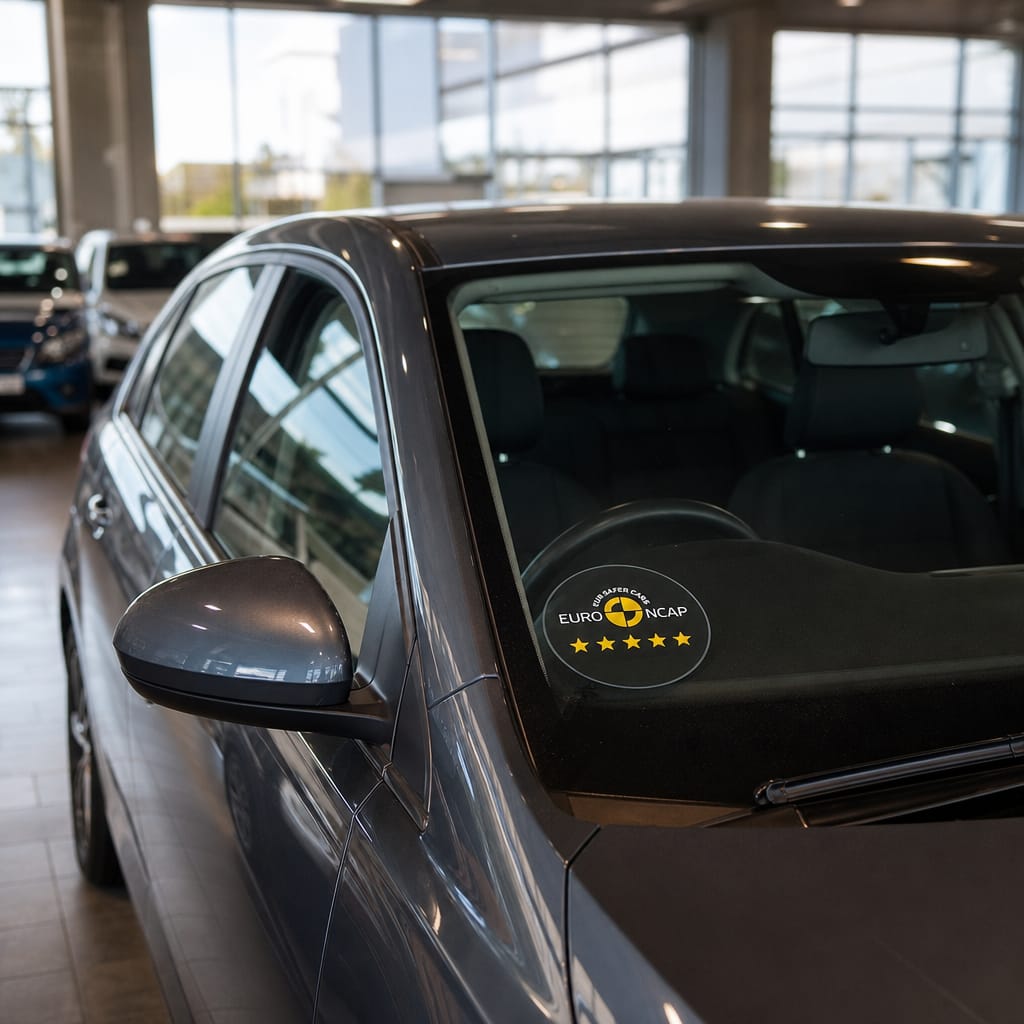
“Euro NCAP five stars” is emblazoned across the used car ad, and there – printed on the windscreen of the car in the showroom – is the starred sticker of maximum safety – five out of five.
The ‘Euro NCAP five stars’ used car ad reference denotes that the car was awarded 5 Euro NCAP stars in 2016. The Euro NCAP test was rewritten in 2018 and again in 2020. Therefore a car that scored full points on the test used pre-2018 would probably score around 3 stars today.
The Stars Were Real. The Test Has Moved On.
Euro NCAP doesn't measure absolute safety. Its aim is to drive the industry forwards. Therefore the safety standards have to keep rising. A car with good safety has to be good against the current test parameters – and if those test parameters never changed, then there'd be no point to NCAP within a decade.
So every few years the bar is raised: new crash scenarios are tested, pedestrian protection is tested more strictly and requirements for features like lane keeping, automatic emergency braking as well as, increasingly, test scenarios to assess how a car returns control to the driver from its driver assistance systems are introduced. A family hatchback from 2015 that scored five stars was almost certainly a genuinely good car. But it was tested against a question that has since been retired, before the full vulnerable road user protocol existed, before lane support requirements and before post-crash safety was weighted as it is now. The five stars awarded to it reflect how good it was against that retired question.
Who Is Actually Running This?
NCAP is not a government agency. Euro NCAP is a private consortium, funded by motor clubs, consumer organisations and transport authorities in Europe. Therefore it is not a regulator and the testing of cars is not compulsory by law. Most manufacturers submit their cars, because five stars is worth real money in advertising, but there are a few who do not submit some models. It’s as well to remember this when comparing models and one of them has no NCAP test result.
The habit of stamping a number on something and presenting it as a permanent truth turns up in more places than car showrooms. For a similar puzzle in an entirely different context, Damp Has Three Dialects, and They Are Not Saying the Same Thing is worth five minutes.
What to Actually Do With the Stars
The stars still have value, even if they were awarded years ago. The test year for a car rated with 5 stars is shown in the results table on the NCAP website, as well as the test date and the test protocol version used. A test from the last two or three years is more demanding than a test from a decade ago, for example. The stars have no ‘best before’ date, but they probably should have.
—
Does this mean a five-star car from ten years ago is dangerous?
This is NOT because of NCAP. All new cars have to pass separate legally required type approval crash tests to be allowed to be sold in the UK at all. NCAP is a voluntary test programme on top of that required test. An older car that scored 5 stars was safe by the standards of its time. NCAP’s role is to test above and beyond those required standards and to continue to raise the bar year after year, not to declare older cars unsafe.
If testing is voluntary, which cars skip it?
Some niche manufacturers and low-cost importers never submit their models for assessment. A car without an NCAP rating does not have a rating of zero, because NCAP only tests what it is set up to test. But it is legitimate to wonder why a manufacturer selling in a market where safety matters has not gone through the assessment for their model.
Can I find which version of the test a car was scored against?
Yes. All rated vehicles are listed on the Euro NCAP website complete with test year and test protocol. Different protocols have different generations. Hence results from a 2015 test cannot be compared with results from a 2024 test as if they were on the same scale. This is like comparing the marks from two different subjects, with different mark schemes, from different exams.
Do the tests change how cars are built, or just how they are scored?
Both apply. Most manufacturers design new cars with the current NCAP protocol in mind and therefore safety features such as crumple zones, sensors and the way safety systems behave are optimised to achieve a high score. In order for the tests to have an effect on new cars the tests have to become harder with time.