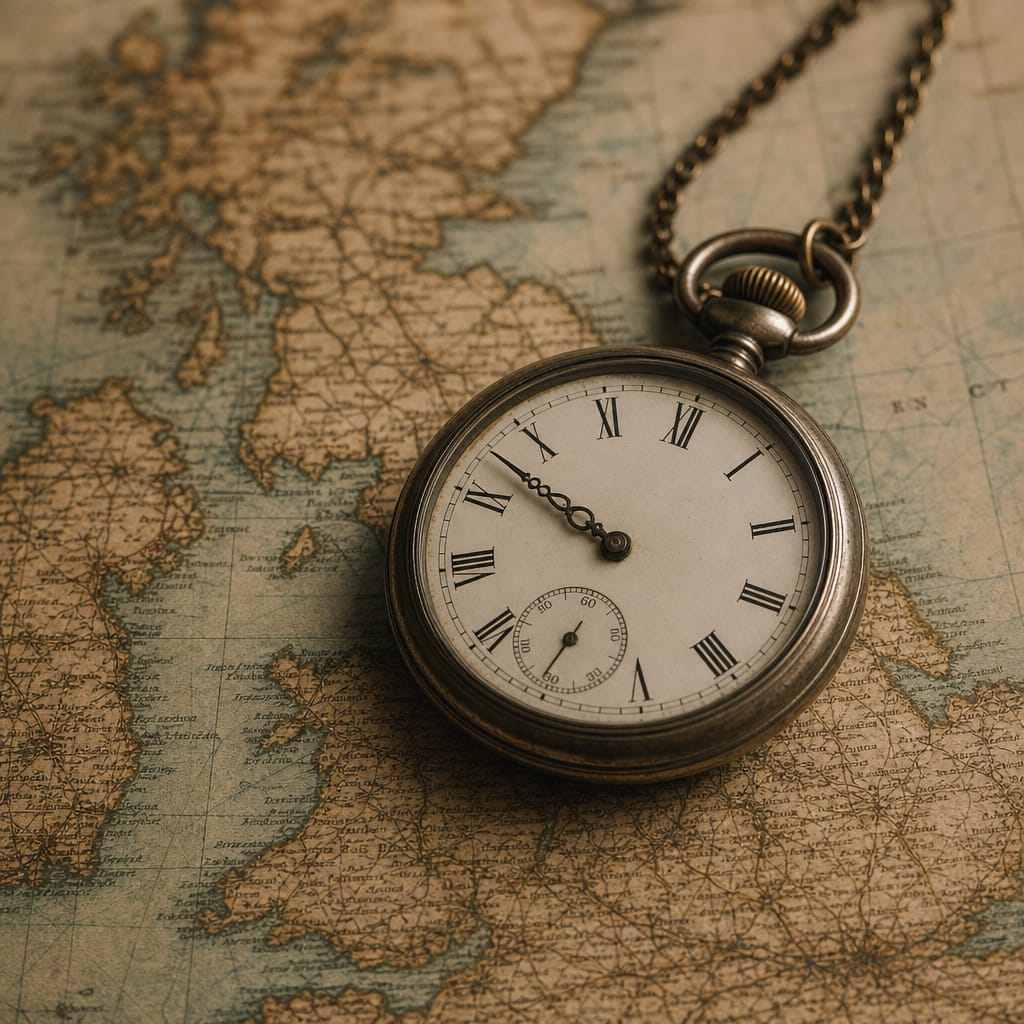
Before 1840, every town in Britain kept its own time. Bristol ran about ten minutes behind London, which was fine when the fastest thing on earth was a horse. Then the railways arrived, and suddenly a timetable that listed "10:00 departure from Paddington" meant something completely different depending on where you were standing. The Great Western Railway solved this by simply declaring that all its stations would run on London time. The rest of Britain eventually shrugged and agreed. Greenwich Mean Time became official in 1880. The age of natural, local time – every church clock quietly doing its own thing – was over in about forty years.
What replaced it was not a fact about the world. It was a political negotiation.
Who decides which time zone a country uses?
In theory, time zones follow the sun. Each one covers roughly 15 degrees of longitude, sliding the clock forward or back by an hour as you move east or west. In practice, they bend almost immediately the moment a government gets involved. France is in the same zone as Spain and yet sits geographically in line with Britain – that happened during the Second World War, when the German occupation moved the clocks to align with Berlin, and France never bothered to move them back. So the Spanish city of Vigo and the French city of Brest face each other across a narrow stretch of water, sharing almost the same longitude, and they tell you completely different times.
Spain has the added quirk of being one of the most westerly countries in Europe while technically running Central European Time – an hour ahead of where the sun would put it. In summer it stays light past ten in the evening in Madrid. Not because of anything geographical, but because a time zone decision made in the 1940s is still running the country's clocks.
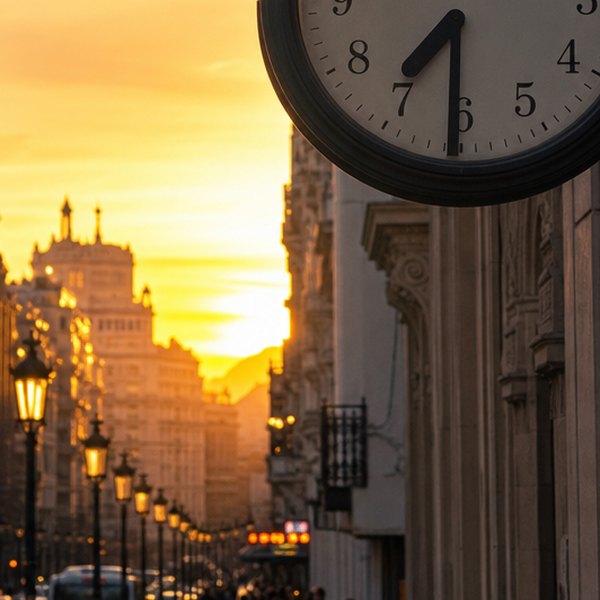
When Franco in Spain changed to Central European Time in 1940 he synchronised with Germany. Nobody changed the clocks back after the war. Madrid, the capital of Spain, is located to the west of Greenwich. Therefore, in winter the sun is at its highest in the sky in Madrid at around 1:15pm, and in summer at around 2:15pm. This is often cited as one reason for late lunchtime and dinner time in Spain. The Canary Islands, however, are on the same time as the UK. Double Summer Time was introduced in Britain during the Second World War in order to make better use of daylight in work hours. This meant that Britain was two hours ahead of GMT. India is on a single time zone for the whole country and sits half an hour off several of its neighbours. It is five and a half hours ahead of GMT.
One Country, One Clock (Whether You Like It Or Not)
China is where this gets genuinely extraordinary. The country stretches across what would naturally be five separate time zones, from its eastern seaboard all the way to the Xinjiang region in the far west. In 1949 the new government declared the whole lot would run on Beijing time, partly as a statement of national unity. The effect in the west of the country is that the sun rises at what the clock calls nine in the morning and sets around ten or eleven at night in summer. People in Xinjiang often quietly run their own informal local time, about two hours behind the official one, switching back only whenever they deal with the rest of the country. Two clocks, running in parallel, inside a single nation.
The Point Where Monday and Tuesday Can't Agree
Then there is the International Date Line, which sounds authoritative and is essentially made up. It zigzags through the Pacific in ways that serve island nations rather than geography. Samoa switched sides of it entirely in 2011, skipping the 30th of December that year, because their main trading partners had ended up a calendar day ahead of them and it was becoming awkward for business. The entire country simply lost a Friday.
So when you land somewhere new and your phone flicks to the local time, just know that number has been through negotiations, occupations, post-war inertia, and at least one deleted Friday before it reached you.
Questions this raises
- Why does Britain still change the clocks twice a year?
- Did anyone resist the switch to railway time?
- Would permanent summer time actually save any energy?