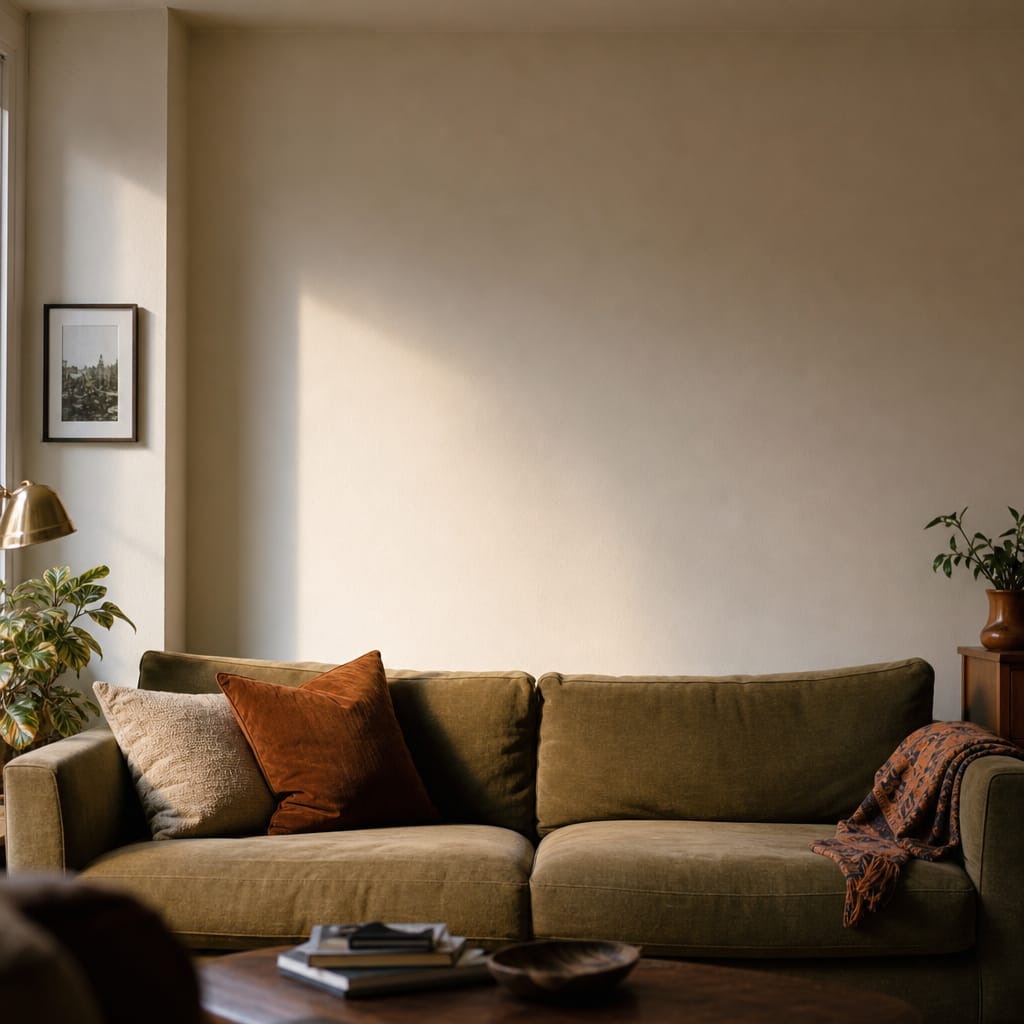
Walk into almost any British living room and you'll find it: the agonised space above the sofa. Too big to ignore, too personal to rush, and somehow – despite containing nothing at all – managing to radiate a faint sense of failure. The blank wall has become the junk drawer of home décor anxiety. But here's the odd thing: that feeling of wrongness, the nagging sense that the gap needs solving, is genuinely new. Not centuries-old instinct. Not some deep human need for covered walls. A few decades old, at most.
When did British homes start hanging art on walls?
For most of history, ordinary British households didn't hang much on their walls because they didn't have much to hang. Paintings were expensive objects, made one at a time by hand, and they lived in the homes of people who could afford to commission them. Everyone else had walls that were simply walls. Not aspirational, not embarrassing – just walls. A bare surface wasn't a problem crying out for a solution. It was a surface.

What changed, roughly, was the printing press catching up with domesticity. Affordable lithography in the mid-nineteenth century meant that reproductions of famous paintings could be sold in shops for the first time. But even then, what went on the wall was fairly functional: religious imagery, a portrait of a dignitary, something inherited. The wall was not yet a canvas for your personality – it was closer to furniture, either there or not there.
What Post-War Magazines Were Really Selling
The real shift came after the Second World War. Britain was rebuilding, the new middle class was moving into new housing, and a freshly energetic wave of interior design magazines arrived to explain to those new homeowners that their homes were projects under constant management. These magazines invented the language of the "finished room" – and a finished room, it turned out, required a considered focal point above the sofa. Not art, necessarily. Just something. A framed print, a mirror, a cluster of photographs. The wall had been reclassified: from neutral to incomplete.
What the magazines were really selling, cleverly and without saying so directly, was the anxiety itself. Once you felt that the wall above the cushions was watching you reproachfully, you needed to address it. The interiors industry – prints, frames, gallery-wall kits, mass-produced canvases – exists partly to service a discomfort that was manufactured from the top down. The print above your sofa is a very recent idea, and the history behind it is genuinely strange.
Is leaving a wall blank actually a design mistake?
None of which means you should leave your wall blank out of principle. If a big print makes a room feel finished to you, brilliant. But next time you stand in front of that empty rectangle, tipping your head and wondering what it needs – it's quite good fun to remember: that nagging feeling was installed in you by a magazine. The wall itself has no opinion.
Questions this raises
- How high should pictures hang above a sofa?
- What size artwork suits a three-seater sofa?