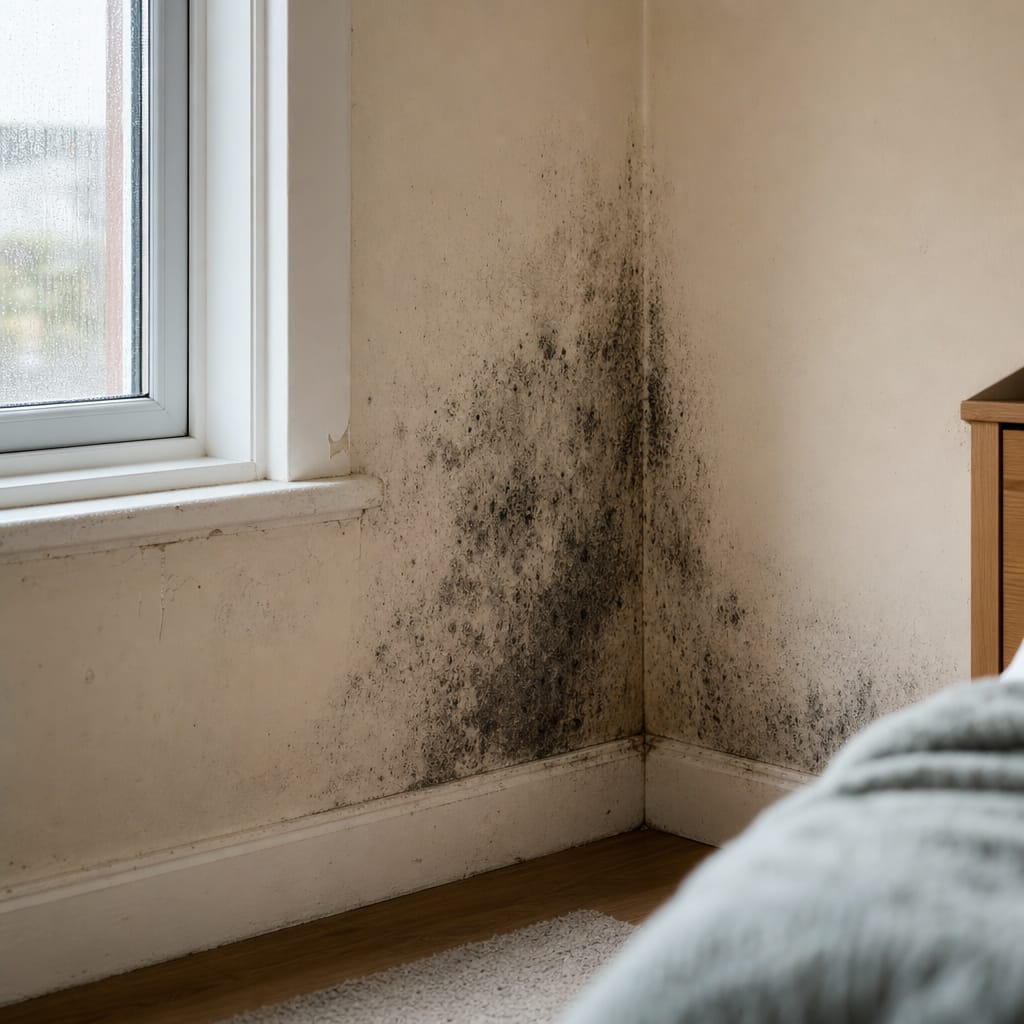
There is almost certainly damp somewhere in your home right now. Not because your home is neglected or unloved, but because British houses spend their entire lives fighting British weather, and the weather usually wins a few small victories while you're at work.
Here's the thing nobody tells you: what we lazily call "damp" is actually three separate problems. Three completely different causes. Three sets of favourite haunts. Three quite different ways of signing their name on your walls. Learn to read the signatures and you will never again stand in front of a grey patch wondering whether to phone a builder or just leave it.
What does condensation damp look like on a wall?
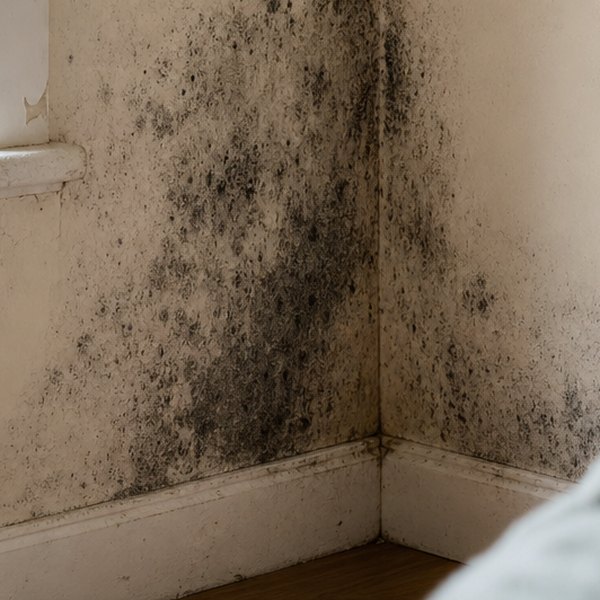
Condensation is the most common of the three, and the one most often misdiagnosed. This is not water getting in from outside – this is water you made yourself, by breathing, cooking, showering and existing indoors. Warm, moisture-heavy air drifts around your home until it touches a cold surface – typically the corner of a bedroom wall, the window reveal, the outside face of a chimney breast – and turns back into water. Leave it long enough and you get the furry black mould that decorators paint over and which then reappears within three months, baffled and determined.
The giveaway: it always lives on the coldest surface in the room, usually a corner or north-facing wall, and it tends to be upstairs where warm air collects. Fix it with ventilation and either heating or insulating the cold surface. The cause is inside the room, not outside the house.
Rising Damp: The Slow Climb
Rising damp is rarer than people think. It is also the most over-diagnosed thing in the British property trade, because treating it costs money. It happens when groundwater wicks upward through brick or stone via capillary action, like a paper towel soaking from the bottom. A functioning damp-proof course stops it. An old, failed or absent one doesn't.
The signature here is unmistakable once you know it: a tide mark, usually no higher than a metre above the floor, often with a faintly salty, white crystalline residue on the surface called efflorescence. Always at the base of external or solid walls, often worse in winter, it tends to damage the bottom courses of plaster while leaving the wall above perfectly dry. Importantly, it never appears upstairs.
How do I tell rising damp from penetrating damp?
This is water finding a physical route in: a missing roof tile, a cracked render, a failed pointing between bricks, a blocked gutter sending water sheeting down the wall. Unlike rising damp, it can appear at any height – mid-wall, ceiling, around a chimney stack, beside a window frame. It often arrives after heavy rain and retreats as things dry out, which is the tell.
The shape matters. Penetrating damp typically forms a spreading, irregular stain rather than a neat tide line. Follow it upward and you'll usually trace it to a defect – a fault in the building's skin that the water is patiently exploiting every time the clouds open.
For a more detailed look at what happens when these things go ignored for long enough, The Quiet Rot You Don't Notice Until the Ceiling Falls In.
Read the three together and your walls become legible. Low down with a tide mark: rising. Spreading stain that comes and goes with the rain: penetrating. Furry patch in the coldest corner of the room: you just need to open a window more.
Questions this raises
- Does rising damp actually exist?
- When should I call a builder about a damp patch?