
Every four years, somebody runs or swims something impossibly fast and the commentator loses their mind. World record! And we all picture human progress: the lonely athlete at 5am, the meal plans, the marginal gains. That picture isn't wrong. But it's leaving out a fairly large co-author.
A world record is, at least in part, a technology reading. The human is in there, obviously. But so is everything they were wearing, standing on, swimming through, and measured by. Change any of those and the number changes – sometimes by a startling amount.
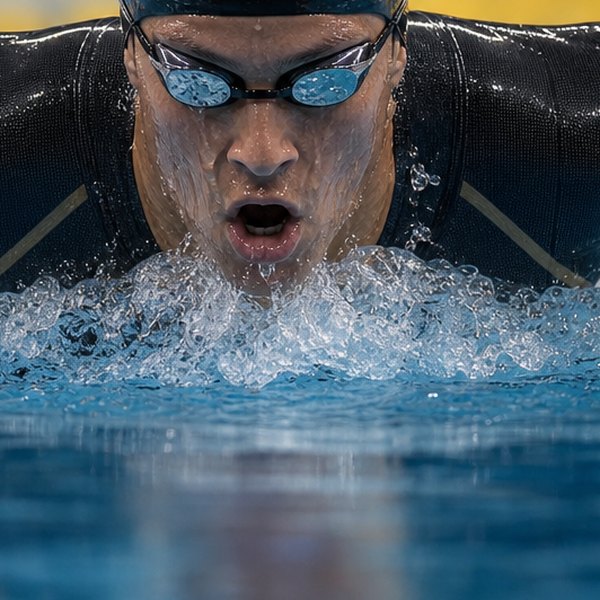
Why were polyurethane swimsuits banned in 2010?
The clearest example is the polyurethane swimsuit era, roughly 2008 to 2009. Manufacturers figured out that a full-body suit made from a specific kind of buoyant, drag-reducing material could make a swimmer measurably faster without them doing anything differently. The suits trapped air. They reduced body oscillation in the water. They compressed the body into a more hydrodynamic shape. And swimmers who wore them at the 2008 Beijing Olympics broke 25 world records in the pool. Twenty-five. In one Games.
FINA, the sport's governing body, eventually banned the suits in 2010. Several of those records still stand today, which means the current world record holder in certain events is not necessarily the fastest human who ever raced in legal kit. They are the fastest human in a particular kind of kit that no longer exists.
The Foam Under Your Feet
Running has its own version. Carbon fibre plates embedded in thick, bouncy foam midsoles – most famously by Nike, though others followed quickly – appeared in elite marathon racing in the mid-2010s and the times dropped almost immediately. Eliud Kipchoge's sub-two-hour marathon in 2019, done in a prototype shoe, wasn't ratified as a record partly because the pacing setup didn't meet the rules. But his subsequent official record runs were done in legal versions of the same shoe family, and World Athletics eventually drew a line at 40mm of stack height – though the foam itself, springier and more resilient than anything that existed before, is still there, bouncing energy back into the foot with every stride.
The shoe is doing some of the work. How much is genuinely contested, but estimates hover around one to two minutes off a marathon time. In world record terms, that's enormous.
Even the Course Moves
And then there are the definitions. A marathon is 26.2 miles, which sounds fixed, but the rules also say the start and finish cannot be more than 50% of the race distance apart as the crow flies – to stop organisers setting up a gentle point-to-point downhill from a mountain. The altitude rules are specific too. Change any of it and a time run on one course isn't comparable to a time run on another, even at the same distance.
So the next time you see a world record broken and someone calls it proof of human progress, they're right. But the equipment and the rulebook are quietly taking a bow at the back of the stage. The number in the record books is always a collaboration between an athlete and the specific moment in history they happened to race in.
Questions this raises
- Do any swimming records from 2009 still stand?
- How much do carbon-plate shoes improve marathon times?
- Should records set with banned kit be wiped?