Somewhere in the basement of every major British newspaper, up until the 1980s, there was a room that smelled of hot lead. Linotype operators cast individual lines of type in molten metal. Compositors assembled those heavy slugs into columns, measured them with a ruler, and when a story ran long, reached for something sharp and trimmed from the bottom.
Not from the middle. Always from the bottom. Because the story was written to make that safe.
The Inch That Calibrated Everything
A column inch was one inch of vertical space in a printed column. Advertising was sold in them, editorial was measured in them, and if a story of eight column inches needed to fit into six, the compositor didn't ring the journalist. He cut.
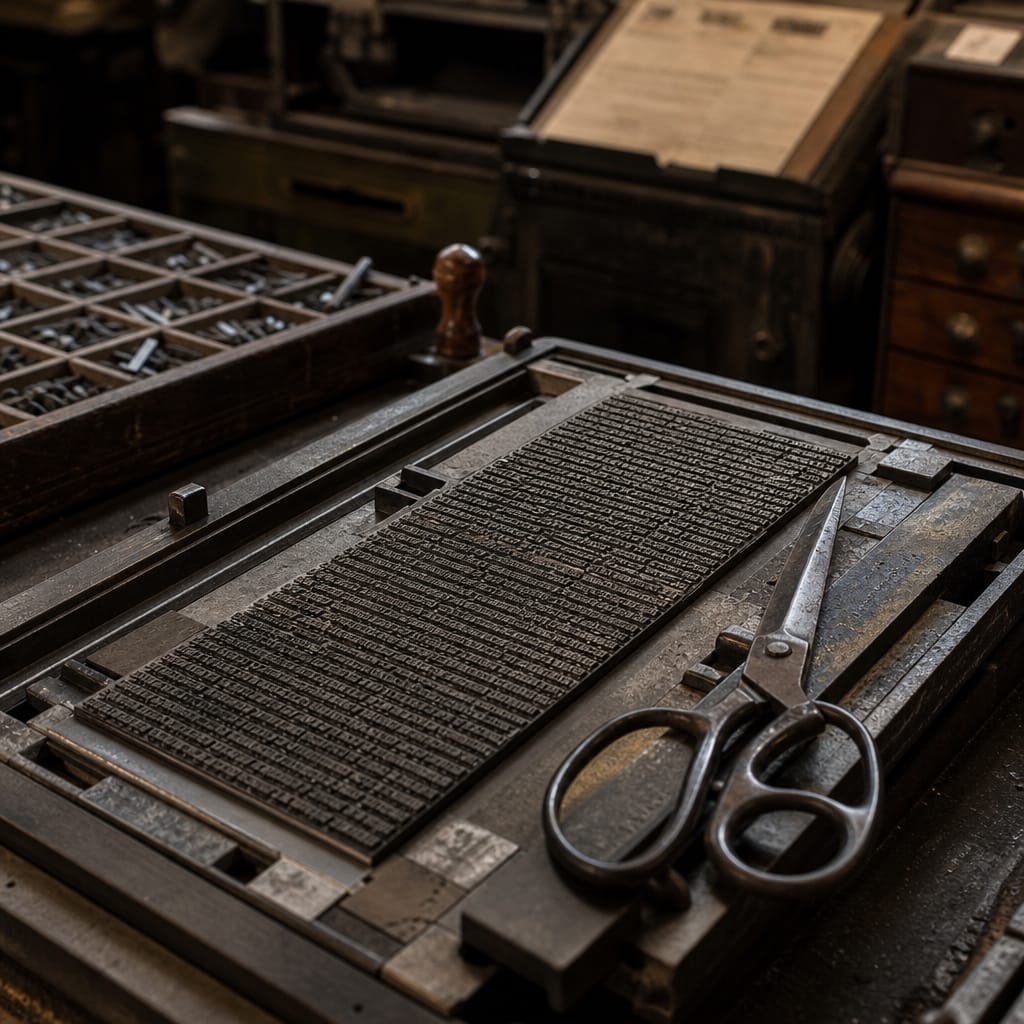
This is why the inverted pyramid exists. Most important fact first. Context second. Background, colour, and the bit about the mayor's reaction third, fourth, fifth. The structure was not dreamed up by a journalism professor as an elegant theory of communication. It was an engineering tolerance. Write it this way and anyone can lop an inch off the bottom without the story falling over, without re-reading a single word.
Inherited structures in daily life – the kind that persist long after the reason for them has gone – are everywhere once you start looking. The Feeling of Home Is Sharpest the Second You Walk Back Through the Door finds them in a different room entirely, if you want the same thought applied somewhere closer to home.
The Room Closed. The Rule Stayed.
Hot-metal compositing rooms were largely gone from British national newspapers by the mid-1980s. The Wapping dispute of 1986 was, in part, about exactly this: Murdoch moving News International to computer-based typesetting, the print unions resisting the end of their craft, and losing. The Linotype machines went. The molten lead went. The ruler and the scissors went.
The inverted pyramid stayed.
It is in every journalism textbook published since. Every journalism course in the country teaches it. Nobody explains why, exactly. "Clarity" is the usual answer. "Reader attention spans." True enough, as far as it goes. But the real reason is older and more mechanical than any of that.
News is still being written to a cutting tolerance that no compositor has used in forty years. The ghost of a bloke with a metal ruler is still standing in every online article, quietly insisting that the last paragraph is the one that matters least.
—
Does the inverted pyramid actually help readers, or is it just inertia now?
It does help, as it happens – starting with the most important information suits the way most people skim a story. But that is almost a coincidence. The structure was optimised for the compositor's convenience, not the reader's. The benefit arrived after the rule was already baked in.
When did British newspapers actually move away from hot-metal type?
Most nationals made the switch through the late 1970s and into the 1980s. The Wapping dispute of 1986 was the sharpest break – Murdoch's move to computerised typesetting at new Wapping premises – and the rest of Fleet Street followed within a few years.
Are there types of journalism that don't use the inverted pyramid?
Yes – features, long-form profiles, investigations. These tend to build toward a point rather than front-load it, more like a short story than a police report. The inverted pyramid is really a hard news convention, and it was never meant to apply to everything.
Why do online editors still cut from the bottom when there is no space limit?
Old habits in any craft outlive the conditions that created them. Editors were trained by editors who were trained by editors who worked alongside compositors. The muscle memory runs very deep. There is also a reasonable case that length discipline is still useful for its own sake online – but that is not the reason the rule was made.