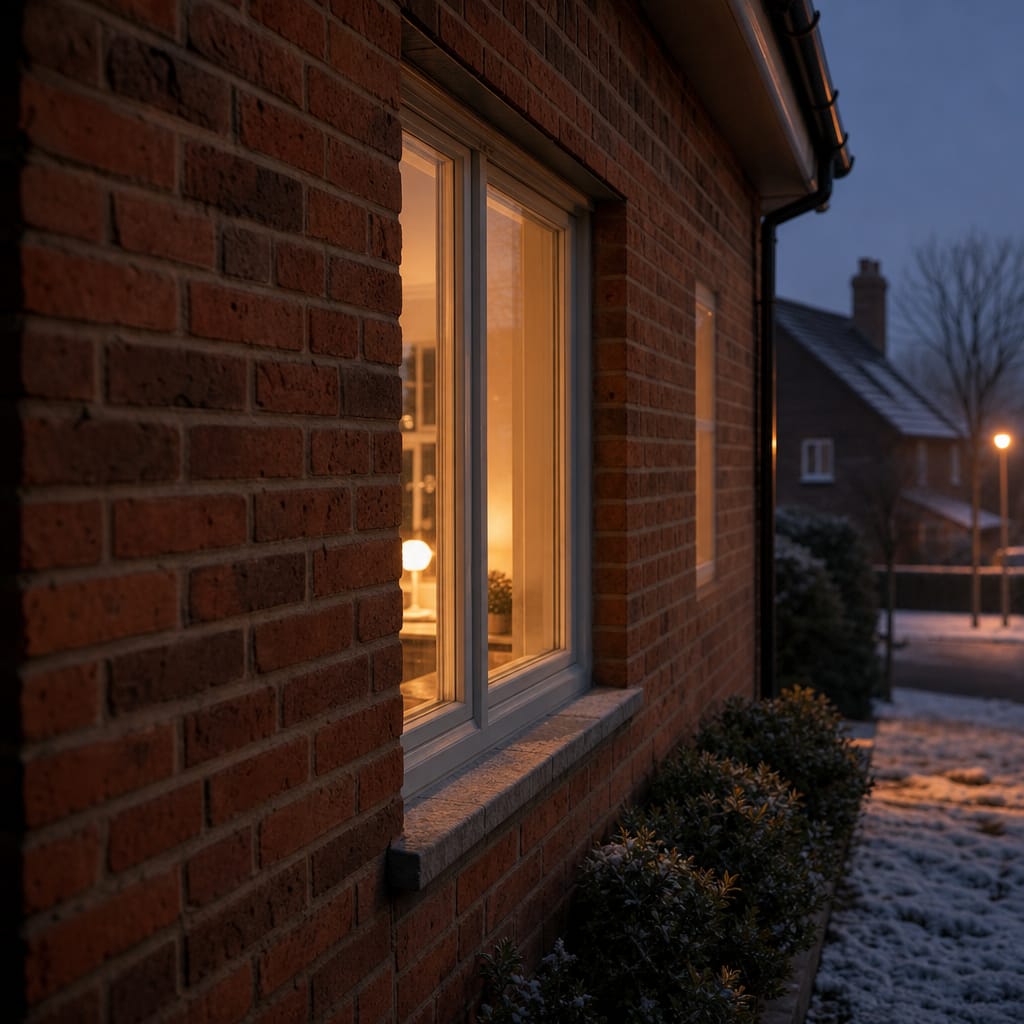
Put your hand flat against an outside wall on a January evening. Cold, isn't it? Not because cold is getting in, exactly, but because warmth is getting out. Your house is exhaling heat through every surface it has, continuously, all night, like a bath slowly going cold the moment you stop running the tap. It doesn't care what you paid for it. It's just obeying physics.
And physics, it turns out, is relentless.
Conduction: Heat Through Solid Material
There are three ways heat escapes a building. They work simultaneously, pulling in different directions, which is why tackling one and ignoring the others leaves you still a bit chilly and vaguely baffled. The first is conduction: heat travelling through solid material the way it moves along a metal spoon sitting in a hot drink. Your walls, your floor, your roof joists – all of them are conducting warmth outward, some faster than others. Brick is a better conductor than wood; concrete is worse than either. A solid wall gives heat a fairly direct route out, whereas a cavity wall interrupts the journey. Which is the whole point of the gap.
Convection: Heat Carried by Moving Air
The second is convection, which is the one most people picture without realising it: warm air rising, touching a cold ceiling or a draughty window frame, giving up its heat and sinking back down again, cool and heavy. Then it warms up and does the whole thing again. Your house is full of slow, invisible loops of air running in circles, spending their warmth against every cold surface they meet.
Radiation: Heat as Invisible Light
The third is radiation. Heat travelling as invisible light, no material required. Stand near a single-glazed window at night and you can actually feel this one: warmth leaving your body toward the cold glass like a tiny, continuous sunset happening in your living room.
Each Route Needs a Different Fix
Now here's what's interesting. Each of these asks for a different solution. Conduction wants insulation – material that traps air in tiny pockets (fibreglass, rockwool, rigid foam) so heat has no easy path through. Convection wants draught-proofing and warm surfaces, so the air's little journeys become shorter and less punishing. Radiation wants low-emissivity coatings on glass, the kind that bounce long-wave heat back into the room instead of letting it whistle straight through.
Most of us fix one thing – bang some loft insulation up there – and wonder why the bills don't fall by as much as we expected. The other two mechanisms simply carry on regardless, cheerfully filling the gap.
This is also why a poorly insulated home's energy waste compounds quietly, year after year. The heat it loses in December 2024 costs more than the heat it lost in December 2019, because energy prices have moved and the real value of what you're wasting shifts constantly. Much like money sitting still erodes without you noticing. The loss is invisible until someone does the arithmetic.
Your house isn't broken. It's just very, very honest about the laws of thermodynamics. It will keep telling you the same thing, in draughts and cold spots and eye-watering bills, until you listen to all three of them at once.
Questions this raises
- Which insulation gives the biggest saving for the money?
- How much heat escapes through a solid brick wall?
- Does draught-proofing beat loft insulation on cost?
- Why does one room stay cold when the heating is on?