Every time you press play on a song or load up a film, something a little presumptuous is happening. A piece of software is looking at all that sound and colour and light, making a series of very confident guesses about what you personally are capable of noticing, and then quietly binning the bits it's decided you'll miss. You never gave it permission. It just knows things about you.
This is what compression actually is, at least the interesting kind. There's a dull version of the story – files get squashed so they fit on your phone or stream without buffering. Fine. But the mechanism underneath is stranger than that. It isn't just tidying. It's predicting you.
Can most people actually hear the difference with lossless?
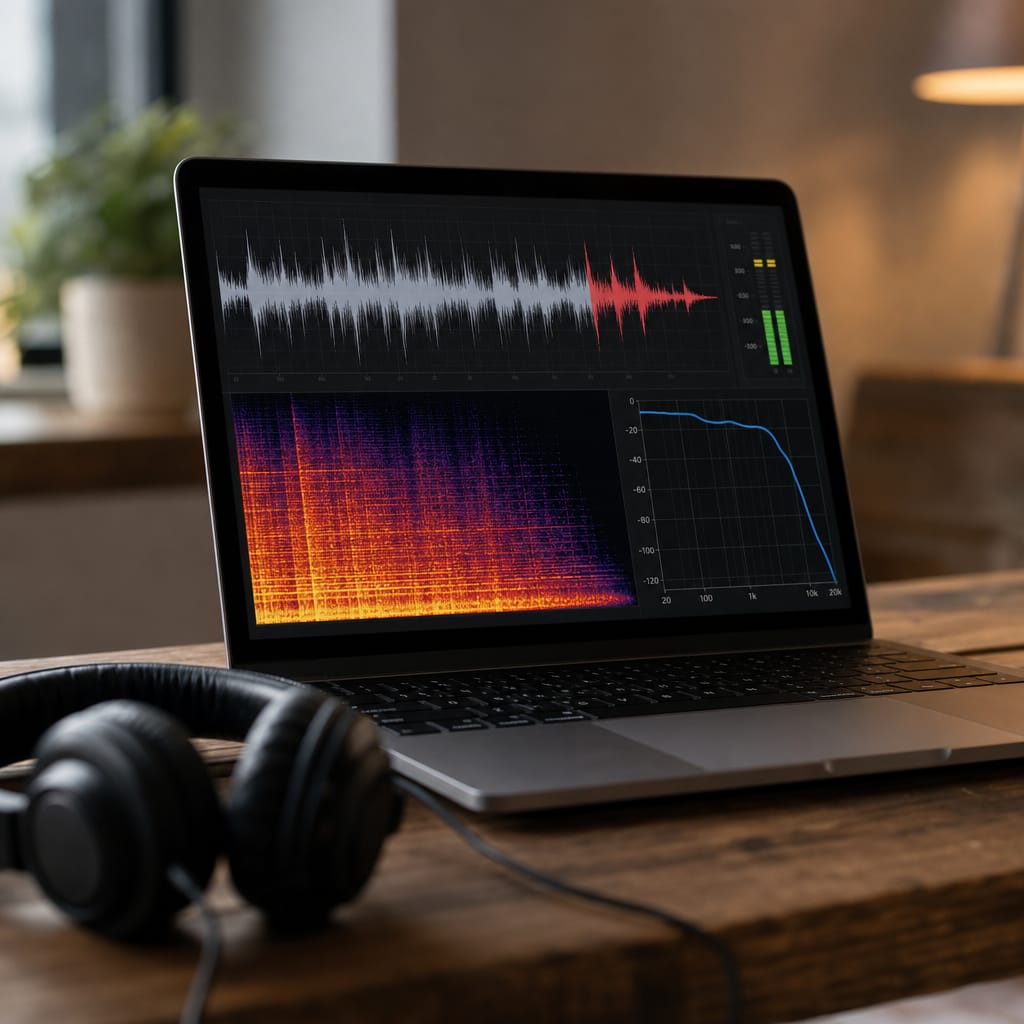
Take an MP3. When audio engineers first started working out how to shrink music files in the 1980s, they didn't just turn everything down a bit. They studied what human hearing actually does, and found that it has some very specific blind spots. A loud sound at one frequency will effectively drown out quieter sounds nearby – a phenomenon called auditory masking. In that moment, your ear genuinely can't hear them. So MP3 compression finds those moments and simply removes the sounds you wouldn't have noticed anyway.
It also throws away the frequencies above roughly 16 kilohertz for most adult listeners. By the time you're out of your teens, you've largely stopped being able to hear them. The algorithm knows this. It's working from a statistical portrait of the average human auditory system, applying that portrait to you, and making cuts accordingly. Whether you're 22 or 62, it's already decided what your ears can manage.
What Your Eyes Throw Away at the Edges
The same logic drives JPEG compression and the way streaming video works. Your eye's ability to distinguish fine colour detail is genuinely much weaker than its ability to pick up brightness and contrast. You see the shape of something before you see its exact shade. So JPEG images quietly reduce the colour information in a picture, particularly in areas away from the focal point, while keeping the brightness detail sharp. Hold a compressed image up against an uncompressed one and you often can't tell the difference – that's not the algorithm being lucky. It's the algorithm understanding how your visual system is wired.
Streaming video takes this further. It stores only what changes between frames rather than every frame in full, because your eye is much better at tracking motion than it is at cataloguing still detail.
The Portrait Inside the Algorithm
What's genuinely odd about all this is that somewhere inside every piece of lossy compression – every JPEG you've ever shared, every streaming service you've ever used – there is a working model of a human being. Not you specifically, but a well-researched generalisation of how human senses operate and where they run out of road. The algorithm isn't a miniaturiser. It's a theory of perception with a delete button.
Most of the time, it's right about you. That's the unsettling part.
Questions this raises
- Why does streaming video look blocky in dark scenes?
- How much data does compression really throw away?
- Does re-encoding a file repeatedly make it worse?