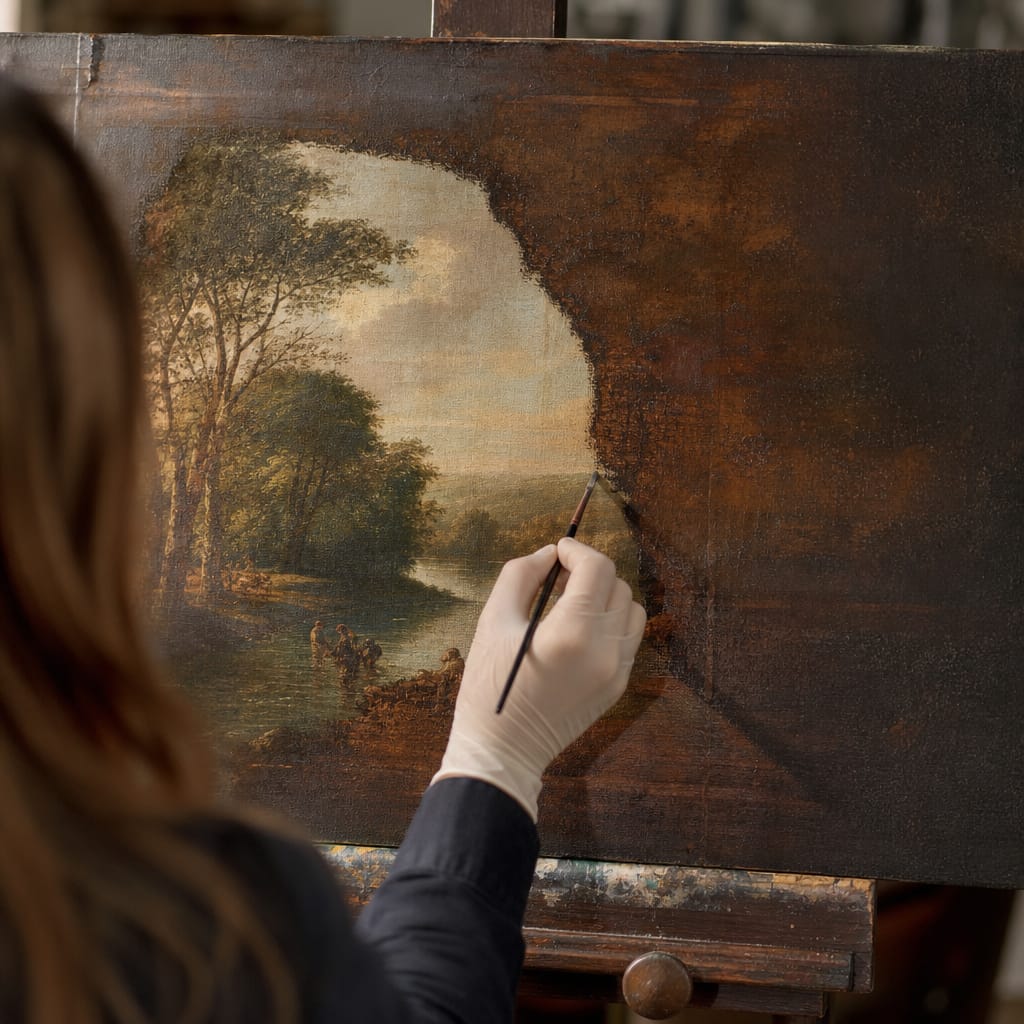
Take a long look at a Vermeer. That quiet, slightly dull grey-green on the woman's sleeve, so understated and modest. Now consider this: Vermeer himself never saw that colour once in his life. What he painted was vivid, grassy, almost electric – and somewhere in the centuries between his brush and your eyes, chemistry stepped in and quietly wrecked it.
This happens more than most people realise. It happens in patterns. The paintings hanging in galleries across Britain aren't frozen moments. They're slow chemical reactions that stopped being under anyone's control the day the varnish dried.
When Green Goes Bad
Vermeer, like most painters of his era, loved a pigment called copper resinate – a rich, jewel-like emerald green made by dissolving copper in tree resin. It was gorgeous. It was also chronically unstable. Exposed to light and air over decades, it breaks down and turns a murky grey-brown. The hedges, the velvet, the garden glimpsed through a window. Things that were once lush green punctuation marks in a composition have quietly faded into the background. The spatial depth that Vermeer carefully arranged has collapsed, and figures that were meant to stand in front of bright foliage now hover in front of nothing much.
This wasn't a gradual fading either. It was a chemical conversion – the copper compound turning into something genuinely different. Not less of the original colour. A different substance entirely.
Lead White and the Vanishing Face
Lead white was the go-to choice for flesh tones, highlights, and anything that needed to feel luminous – and for centuries it worked beautifully. The trouble is that lead white can, under certain conditions, react with sulfur in the air and convert to lead sulfide. Lead sulfide is black.
This is why faces in various Old Master paintings have slowly darkened. The careful, delicate highlights the painter applied have faded to the point where the modelling has gone almost flat. What reads now as a brooding, shadowy portrait may have originally looked lit from within – the sitter's cheekbones catching light, their eyes alive. The darkness isn't atmosphere the painter chose. It's corrosion.
The "Original" That Never Was
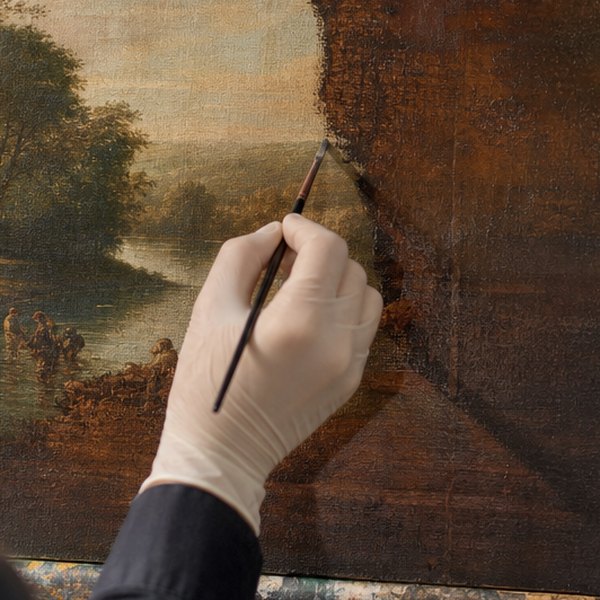
Conservators working with X-ray and infrared imaging have been finding this out for years, and it keeps being unsettling. The version we call the masterpiece – the one reproduced on postcards and taught in art history lectures – is often the chemical endpoint of a process the painter couldn't have predicted. Nobody mixed up a paint for "how it'll look in 300 years". They mixed it for how it looked on the day.
Which puts you, standing in front of any painting older than a couple of centuries, in a genuinely odd position. You're seeing something the painter never intended you to see, and would probably find distressing. The composition you're reading as deliberately sombre or muted may have been, once, bracingly bright. Full of colour contrasts and spatial tension that no longer exist.
What you're looking at isn't the painting. It's what time made of it.
Questions this raises
- Can conservators reverse a pigment that has changed?
- How do galleries know what the original colour was?
- Which other pigments have shifted over the centuries?
- Does modern paint suffer the same problem?