Somewhere around 1997 a teenager in a south London classroom was learning that the photograph on the front of a newspaper has been chosen by someone for a reason. They also learned that ‘asylum seeker’ and ‘refugee’ are two terms used to describe one person but are not interchangeable, and that a handful of men owned the majority of the papers that their parents read each morning. It was Media Studies, the subject that Britain’s press agreed was soft.
The Decoder Ring in the Timetable
The GCSE started in the late 1980s with a rather unusual goal for an exam: to encourage suspicion. The front pages of newspapers were scrutinised to see why a particular story had been included with certain images and words. The media ownership was mapped with Murdoch located in one place and Rothermere in another. Two newspapers on the same event were compared to see what had been left out of each of them. The more advanced students were taught about the concept of framing and how the way something is presented to us shapes the opinions we form about it.
The Editorials That Proved the Point
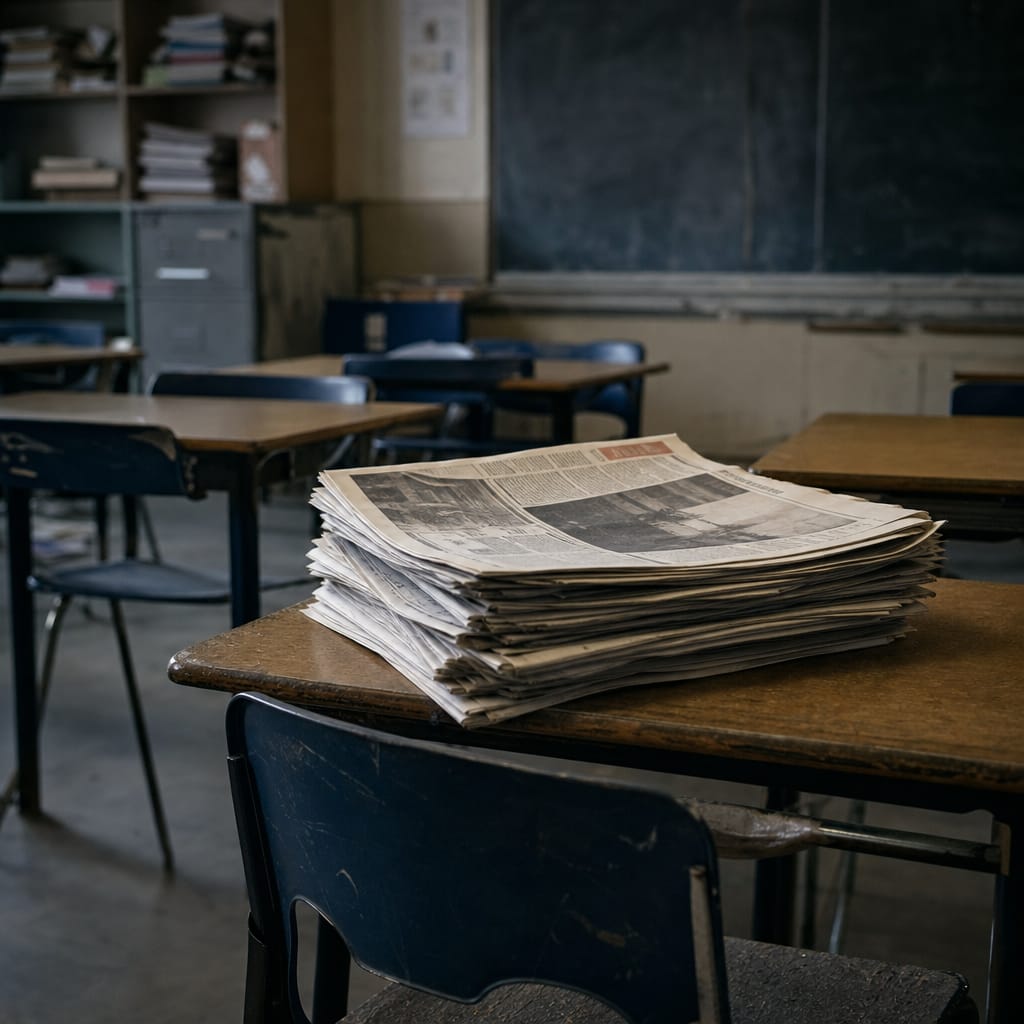
A number of British newspapers ran a sustained campaign to denigrate the subject from the mid-1990s onwards. Editorials were written to describe the subject as a ‘doss course’ or ‘soft option’ which offered ‘thin content’ dressed up as a qualification. Politicians endorsed this view and, behind the scenes, universities stopped counting the subject for admissions purposes. The message was consistent: these were not ‘proper’ skills.
None of the editorials examined the content of the subject. Nor did they argue against elements of the subject in particular – for example, that understanding the ownership structure of a media outlet is of little relevance, or that understanding how a headline is chosen is of little use. But no, instead the editorials just repeated the verdict that the subject was soft and worthless, from a position of assumed authority, without evidence, using loaded language, confident the reader would take their word for it.
This editorial could have been dismantled by someone who has done Media Studies. All of the moves are clear for someone with that level of editorial awareness. Use your editorial power to tell a generation of students that a lesson which helps them to question editorial power is not worth them spending their time learning. Make sure it is loud enough that nobody teaches the lesson.
The idea that expert language is sometimes a barrier rather than a guide is developed in Damp Has Three Dialects, and They Are Not Saying the Same Thing.
The Gap That Stayed
The subject didn't vanish entirely, but it was stigmatised thoroughly enough that it never became a default part of how British teenagers were taught to read the news. That gap did not close on its own. The news kept arriving.
—
Was there actual substance in the Media Studies curriculum, or was it just watching telly?
This is real content. Pupils analyse ownership structures, examine how stories are selected and presented, compare coverage of the same event in different media, and in A-level classes also find out whose voices tend to be presented as that of an expert and whose tend to be presented as that of a subject in a news story. The "watching telly" stereotype came mostly from the editorials and not from the content of the syllabus.
Did universities genuinely refuse to accept it?
Many did. The subject appeared on various informal lists of subjects that admissions tutors at various universities would not count, some of them explicitly ruling Media Studies out. As a result, schools concentrated on helping their pupils get into university and therefore tried to put pupils off studying the subject. In this way the subject was quietly killed off without ever being formally abolished.
Could newspapers really not have seen the irony?
They might not have. An editorial writer arguing in favour of serious journalism against a 'trivial' GCSE is probably not aware that this is what the course teaches. The irony does not have to be generated by 'bad faith' on the part of the press. It is sufficient that the press examines everything, and fails to examine itself.
Is it too late to pick up these skills if you missed them?
No. The tools are the same whether you got them at 16 or not. Take any given story on any given day and read two different news outlets’ take on it. Look for what they included and what they didn’t. Look at how they are describing the same person or event in the story. The gap between how two different news organisations are covering any given story is where you learn.