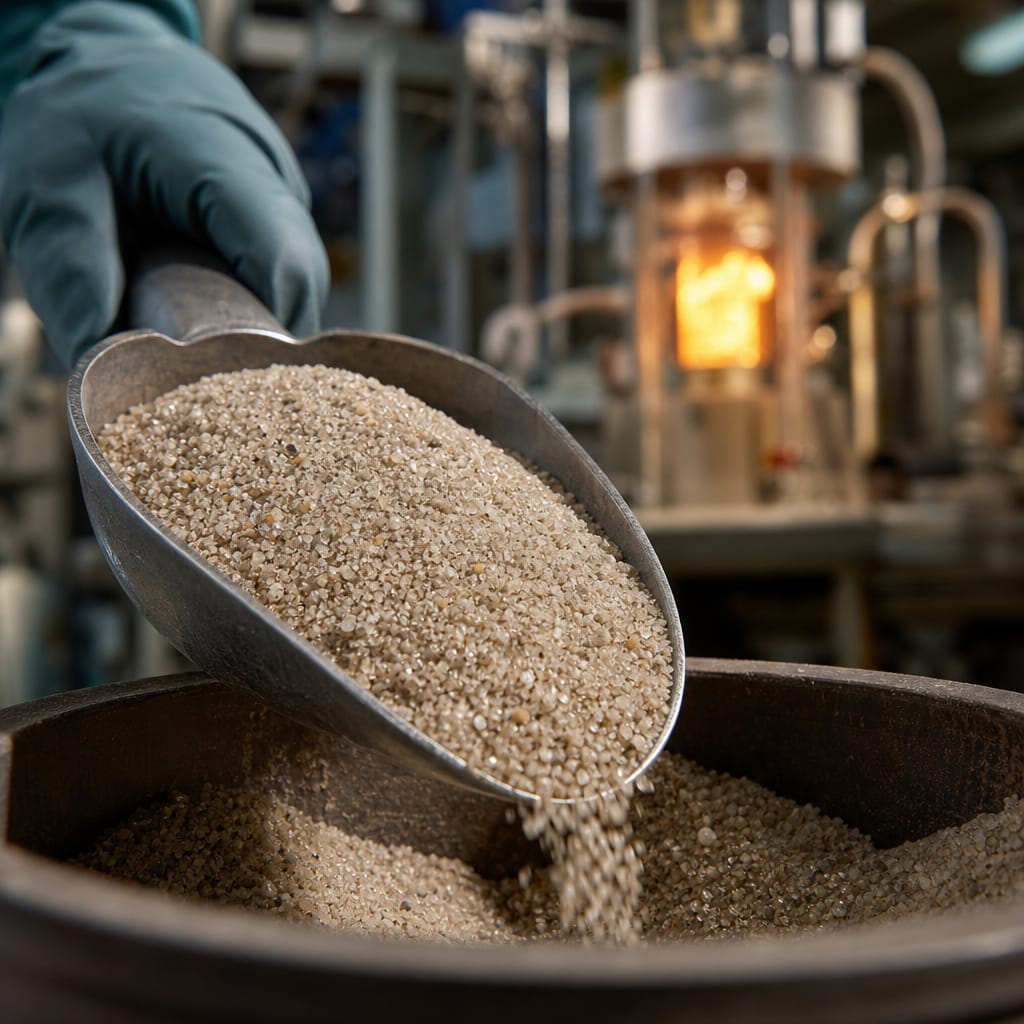
There is a beach somewhere – Chesil, Camber, take your pick – where you could scoop up a handful of sand and be holding, chemically speaking, almost exactly the same stuff that is inside your phone. Silicon dioxide. The main ingredient in both is silicon, and it is arguably the most important material in human history right now.
It is also, in its natural state, basically useless for the job.
That gap between "beach sand" and "the thing running your laptop" is where one of the most extraordinary industrial processes on the planet lives. And almost nobody knows it exists.
Why can’t ordinary beach sand be used directly?
The problem with sand is that it is filthy. Not gritty-feet filthy – chemically filthy. Natural silicon dioxide is riddled with other atoms: iron, aluminium, calcium, titanium, all threaded through the crystal structure at concentrations that sound tiny but are, for a computer chip, catastrophic. A chip operates by controlling the movement of electrons through silicon with absolute precision. An unwanted atom in the wrong place is like a pothole in a motorway for those electrons. The whole thing stops working.
So the silicon has to be cleaned. Not rinsed. Not filtered. Purified to a degree that has no equivalent anywhere in the natural world.
The process starts with blasting the raw silicon with carbon at enormous temperatures to strip away the oxygen. Then it runs through a series of chemical reactions – converting it to a liquid called trichlorosilane, distilling that liquid repeatedly, then converting it back to solid silicon. Each stage strips out more contaminants. By the end, you have something called electronic-grade silicon, and its purity level is nine nines: 99.9999999% pure. One atom of impurity per billion.
How pure does silicon have to be for a chip?
That number is hard to feel, so try this. If the population of Earth were silicon atoms, nine-nines purity would mean roughly eight impurities allowed in the entire human race. Everyone else on the planet: perfect. Eight stragglers – that is your entire contamination budget.
Nature cannot do this. There is no geological process, no living organism, no star-forming nebula that produces matter at that level of chemical uniformity. And by some measures, this makes electronic-grade silicon the purest solid substance ever deliberately manufactured. The only things humans have made that come close are the isotopically pure silicon being developed for quantum computers, where even different versions of the same atom cause problems.
The Sand That Got Complicated
After purification, the silicon is melted again and grown into a single crystal – a cylinder about a metre long, pulled slowly from the melt so every atom lines up in the same repeating lattice. You slice that cylinder into wafers thinner than a human hair. Etch hundreds of chips onto each one using light, with each chip containing billions of transistors, each transistor a few nanometres wide. Smaller than most viruses.
All of it resting on the fact that someone, somewhere, first made the sand clean enough to think with.
Questions this raises
- Where does the sand for silicon chips come from?
- Is the world running short of the right sand?