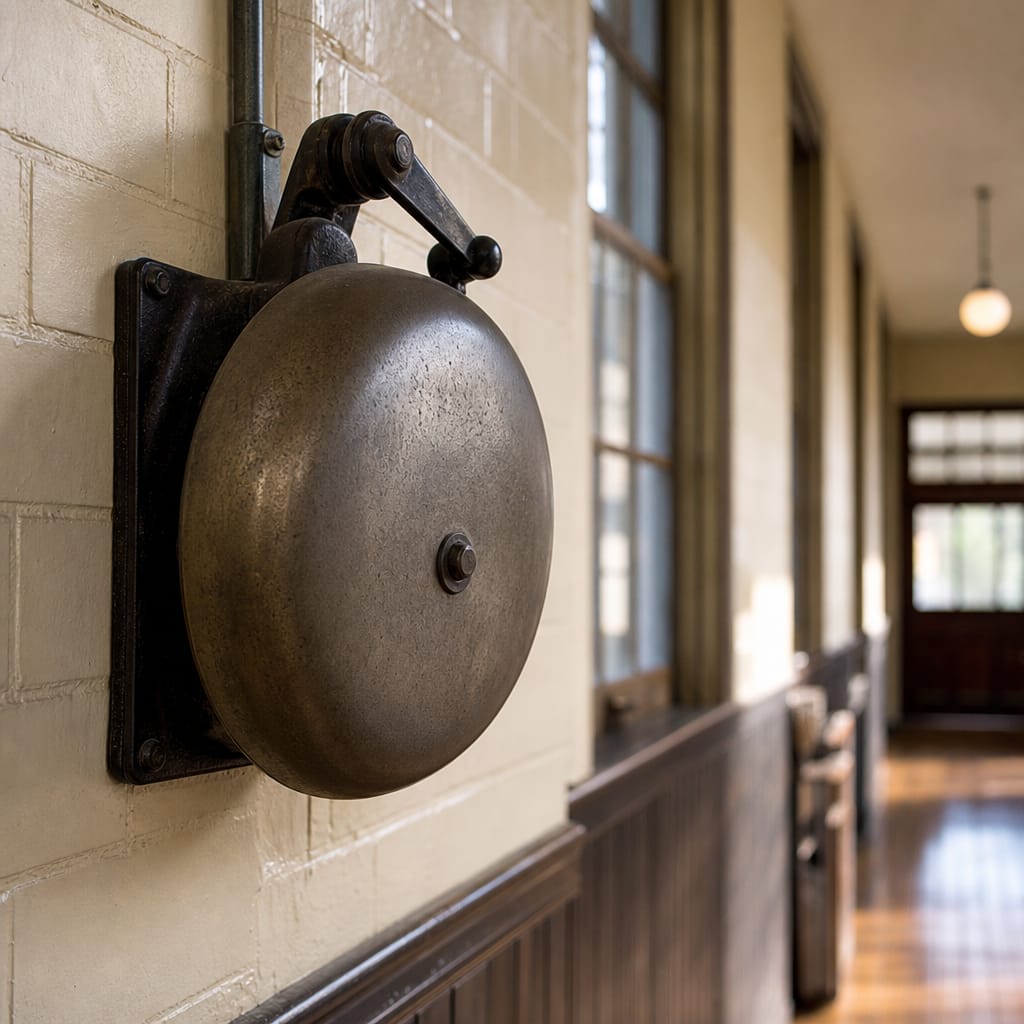
Somewhere in Britain right now, a bell is ringing. Children stop what they are doing, pack up their things, and shuffle off to the next room. Nobody questions it. It feels as natural as morning, as inevitable as Tuesday. But that bell? It is not an educational tool. It is a shift-whistle, and the building around it was designed by people who were thinking very seriously about cotton mills.
How Prussia Turned Children Into Raw Material
In the early nineteenth century, Prussia had a problem. It needed a literate, obedient, standardised workforce – soldiers who would follow orders, clerks who could all read the same documents, factory hands who would turn up on time and do what they were told. The solution was a national schooling system built on industrial logic: take children in batches, process each batch for a set period, move them along the line, test the output. The same model that turned raw wool into finished cloth would now turn raw children into useful citizens.
It worked, in its own efficient way, and the rest of the world noticed. By the late 1800s, the Prussian model had spread across Europe and America. Britain adopted it with enthusiasm. The 1870 Education Act – which brought in compulsory schooling for England and Wales – essentially installed the factory blueprint into law: age-grouped classes, subject periods, standardised testing, and a teacher as foreman.
The Batch Problem
The strangest part, once you actually look at it, is the age-sorting. We group children by the year they were born, not by what they know or how they think or what they are ready to learn. The only other place in life where you are sorted entirely by age is a waiting room. In a factory, you sort by what stage of production something has reached. Children born in the same twelve-month window are assumed to be at the same stage – which any parent of more than one child will tell you is absolutely not how children work.
This produces the famous "relative age effect", something researchers in education have studied extensively. Children born in September consistently outperform those born in August, simply because they are eleven months older when they start school and get labelled as brighter early on. That label tends to stick.
Why has this school model survived so long unchanged?
None of this means that every teacher is a factory foreman, or that nothing good happens inside schools – it clearly does, and a lot of it. But the timetable, the bells, the year groups, the uniform assessment points – none of that came from a theory of how children learn. It came from a theory of how to run a mill. Practical, scalable, and cheap. And then it became invisible, which is the sneaky trick that institutions pull. Once a system is old enough, it starts to look like nature.
So next time you hear a school bell ring, just know: somewhere in the 1820s, a Prussian bureaucrat is gently nodding.
Questions this raises
- How did the Prussian school model reach Britain?
- Do any schools now run without bells or periods?
- What did British schooling look like before this?